Explore French Bulldog health on a full-body dog
Rotate, tilt, and zoom the realistic viewer, then open evidence-informed topics for the airway, ears, eyes, skin, spine, and digestive system.
Open the French Bulldog Health Explorer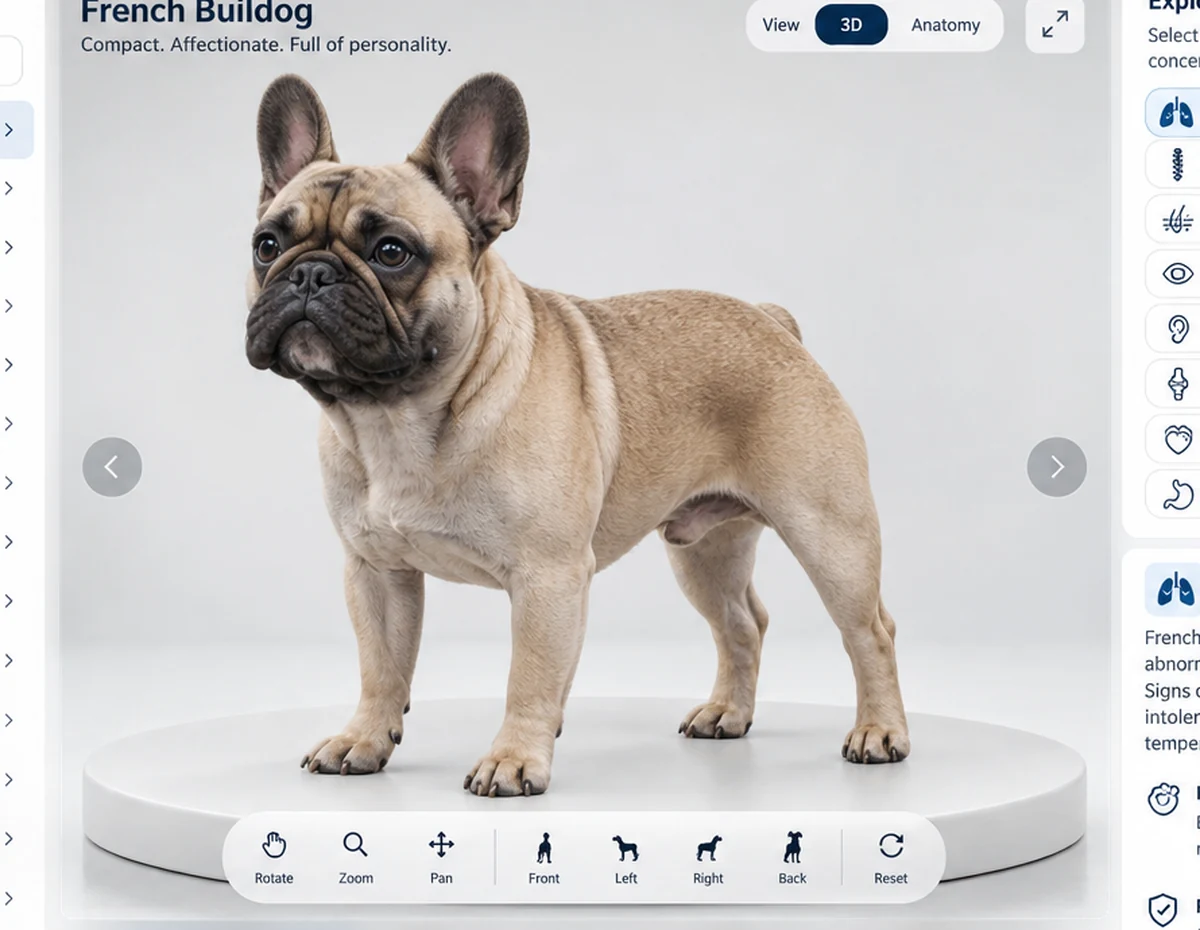
About the breed
French Bulldogs are compact companion dogs known for close attachment to people, expressive behavior, and relatively modest exercise needs. Their popularity does not remove the responsibility created by their body shape. Shortened facial anatomy, skin folds, prominent eyes, and a compact spine can make careful health observation especially important.
Individual dogs vary considerably. Some breathe quietly and remain active within sensible limits, while others develop clinically important airway, skin, ear, eye, digestive, or spinal problems. No owner should be told that obvious respiratory struggle or poor heat tolerance is simply normal for the breed.
This guide separates documented study findings from general care advice. The numbers describe specific UK study populations and periods, not the future of an individual dog in the United States.
Temperament, family life, and socialization
Many French Bulldogs are affectionate, playful, and motivated by proximity to their people. They may enjoy brief training sessions and indoor enrichment more than prolonged endurance activity. Consistent routines can help with house training, settling, handling, and comfort when left alone for short periods.
Early socialization should be calm and controlled. Exposure to people, surfaces, household sounds, car travel, grooming, and appropriate dogs should build confidence without overwhelming the puppy. Avoid using their small size as a reason to skip manners or cooperative care.
Children should learn not to lift, squeeze, chase, or disturb a sleeping dog. Interactions with larger dogs require supervision because a compact body does not protect against rough collisions.
Exercise, training, and enrichment
French Bulldogs need regular movement, but exercise must respect breathing, temperature, age, and fitness. Short walks, indoor play, scent games, and training can provide useful activity. Hot or humid conditions can sharply reduce safe exercise tolerance.
Use a well-fitted harness when recommended and allow frequent rest. Stop activity for unusual noise, distress, weakness, vomiting, blue-tinged gums, or collapse. Difficulty recovering after mild activity deserves veterinary evaluation.
Protect the spine by limiting uncontrolled jumping from furniture, improving traction on slippery floors, and maintaining a lean body condition. These steps cannot prevent every spinal problem, but they can reduce avoidable strain and injury.
Grooming and routine home care
The short coat is easy to brush, but the skin, folds, ears, eyes, nails, and tail area need regular inspection. A fold should not remain damp, painful, malodorous, or inflamed. Cleaning products and frequency should be chosen with veterinary guidance because over-cleaning can also irritate skin.
Ear odor, discharge, redness, repeated scratching, or head shaking should be evaluated rather than repeatedly treated with leftover medication. Eye pain can progress quickly, so squinting, cloudiness, excessive tearing, or pawing at the face is time-sensitive.
Dental care is important even when chewing seems normal. Introduce dog-safe tooth brushing gradually and have the mouth examined during routine visits.
Health at a glance
French Bulldogs deserve particular attention to breathing, skin folds, ears and eyes. Research identifies concerns to discuss with your veterinarian, not a prediction that your dog will develop them. The young UK populations studied do not represent every French Bulldog.
A study finding describes the dogs and method used in that source. It does not predict what will happen to one dog, and different study measures should not be combined into a single risk score.
Breathing and nostril anatomy
In a 2016 UK primary-care comparison, French Bulldogs had substantially higher adjusted diagnostic odds of brachycephalic obstructive airway syndrome and stenotic nares than non-French Bulldogs. These odds ratios are not percentages and do not tell an owner the probability that one dog will need treatment. [2]
Noisy breathing, poor heat tolerance, regurgitation, or difficulty recovering after mild activity should not be dismissed as normal.
Ear inflammation
Otitis externa was recorded in 312 of 2,228 French Bulldogs in UK primary-care records from 2013, a period prevalence of 14.0%. The study captures recorded clinical care in that year and does not establish a US rate or an individual forecast. [1]
Discuss odor, redness, discharge, pain, head shaking, or repeated scratching with a veterinarian.
Digestive signs
Diarrhea was recorded in 167 of 2,228 dogs in the same UK study, or 7.5%. Diarrhea is a symptom with many possible causes, not one breed-specific diagnosis. [1]
Persistent, severe, bloody, or recurrent gastrointestinal signs deserve evaluation.
Eyes and skin folds
Conjunctivitis was recorded in 3.2% of the 2013 study sample, and skin fold dermatitis in 3.0%. Clinical records can miss problems that never reach the clinic, and these percentages should not be transferred to every population. [1]
Squinting, cloudiness, eye pain, fold odor, moisture, redness, or discharge should be addressed promptly.
Spinal and neurologic disorders
The 2016 UK comparison found higher adjusted diagnostic odds for a grouped category of spinal cord disorders in French Bulldogs than in non-French Bulldogs. The row does not provide an absolute frequency and should not be relabeled as a specific intervertebral disc disease estimate. [2]
Sudden pain, weakness, loss of coordination, or inability to stand requires urgent veterinary attention.
Breeding and respiratory assessment
Parent-club guidance includes orthopedic, eye, patella, and cardiac screening, with respiratory function grading listed as an additional assessment for brachycephalic airway function. Screening helps inform breeding and care discussions but cannot guarantee future health.
Ask for the actual results, dates, and respiratory grade rather than only a claim that testing was completed.
How to read the health evidence
Different research methods answer different questions. A veterinary-record study, an owner survey, a screening recommendation, and an odds comparison are not interchangeable. The labels below are repeated in the evidence table so the type of claim remains visible.
The proportion of study dogs with a condition recorded during the stated period. It can include existing and newly identified cases.
The proportion of owners who reported that the dog had experienced a condition before the survey. It is not a completed-lifetime probability.
A comparison with another group after statistical adjustment. It is not a percentage, risk ratio, or individual forecast.
Guidance about testing or record review. A recommendation does not establish how frequently disease occurs.
The sources reviewed did not provide a defensible frequency estimate. That does not mean the condition is absent.
What the research found
Each row keeps the source’s denominator and time period. Percentages should not be added together because one dog can have more than one condition, and different rows may come from different countries or methods.
| Condition and system | Finding and limitations | Measure | Population and period |
|---|---|---|---|
| Otitis externaEars | Outer-ear inflammation was recorded. [1] Limits and age informationOlder UK clinical records; recorded diagnoses can miss unrecognized or unpresented illness. Not a U.S. population estimate or an individual forecast. Age of onset: Not established in the sources reviewed. |
Recorded period prevalence 14.0% recorded period prevalence (312/2,228 dogs); 95% confidence interval 12.6-15.5% |
UK primary care, calendar 2013; 2,228 French Bulldogs. |
| DiarrheaDigestive | A recorded symptom, not one specific underlying disease. [1] Limits and age informationOlder UK clinical records; recorded diagnoses can miss unrecognized or unpresented illness. Not a U.S. population estimate or an individual forecast. Age of onset: Not established in the sources reviewed. |
Recorded period prevalence 7.5% recorded period prevalence (167/2,228 dogs); 95% confidence interval 6.4-8.7% |
UK primary care, calendar 2013; 2,228 French Bulldogs. |
| ConjunctivitisEyes | Inflammation affecting the conjunctiva was recorded. [1] Limits and age informationOlder UK clinical records; recorded diagnoses can miss unrecognized or unpresented illness. Not a U.S. population estimate or an individual forecast. Age of onset: Not established in the sources reviewed. |
Recorded period prevalence 3.2% recorded period prevalence (71/2,228 dogs); 95% confidence interval 2.5-4.0% |
UK primary care, calendar 2013; 2,228 French Bulldogs. |
| Skin fold dermatitisSkin | Inflammation in skin folds was recorded. [1] Limits and age informationOlder UK clinical records; recorded diagnoses can miss unrecognized or unpresented illness. Not a U.S. population estimate or an individual forecast. Age of onset: Not established in the sources reviewed. |
Recorded period prevalence 3.0% recorded period prevalence (66/2,228 dogs); 95% confidence interval 2.3-3.8% |
UK primary care, calendar 2013; 2,228 French Bulldogs. |
| Brachycephalic obstructive airway syndrome (BOAS)Breathing | Higher adjusted diagnostic odds than other dogs; this is not a percentage. [2] Limits and age informationOlder UK clinical records; recorded diagnoses can miss unrecognized or unpresented illness. Not a U.S. population estimate or an individual forecast. Age of onset: Not established in the sources reviewed. |
Adjusted odds ratio Adjusted odds ratio 30.89; 95% confidence interval 20.91-45.64. Absolute frequency is not reported in this row. |
UK primary care, calendar 2016; 2,781 French Bulldogs versus 21,850 non-French Bulldogs. |
| Stenotic nares (narrow nostrils)Breathing | Higher adjusted diagnostic odds than other dogs; this is not a percentage. [2] Limits and age informationOlder UK clinical records; recorded diagnoses can miss unrecognized or unpresented illness. Not a U.S. population estimate or an individual forecast. Age of onset: Not established in the sources reviewed. |
Adjusted odds ratio Adjusted odds ratio 42.14; 95% confidence interval 18.50-95.99. Absolute frequency is not reported in this row. |
UK primary care, calendar 2016; 2,781 French Bulldogs versus 21,850 non-French Bulldogs. |
| Spinal cord disorders, groupedNeurologic | Higher adjusted diagnostic odds than other dogs; this is not a percentage. [2] Limits and age informationOlder UK clinical records; recorded diagnoses can miss unrecognized or unpresented illness. Not a U.S. population estimate or an individual forecast. Age of onset: Not established in the sources reviewed. |
Adjusted odds ratio Adjusted odds ratio 3.0; 95% confidence interval 1.94-4.64. Absolute frequency is not reported in this row. |
UK primary care, calendar 2016; 2,781 French Bulldogs versus 21,850 non-French Bulldogs. |
Screening and health records
Breeding screening is intended to inform breeding decisions and increase transparency. It does not predict every illness a puppy may develop, and it is different from diagnostic testing for a dog with symptoms.
| Test or evaluation | Purpose | Timing and source |
|---|---|---|
| Hip evaluation | Parent-club CHIC screening using OFA or PennHIP; ask to see the actual result. | Ask your veterinarian about timing and the current OFA protocol. [3] |
| Ophthalmologist examination | Parent-club eye screening, separate from predicting future eye disease. | Annual recertification recommended by the club. [3] |
| Patella evaluation | Parent-club kneecap screening. | Ask your veterinarian about timing and the current OFA protocol. [3] |
| Cardiac evaluation | Parent-club heart examination; basic auscultation or advanced echocardiography pathways. | Ask your veterinarian about timing and the current OFA protocol. [3] |
| Respiratory Function Grading Scheme | Club-recommended additional assessment for BOAS. | Official certification from 12 months; younger tests are preliminary. [4] |
| Additional tests to discuss | The club lists tracheal hypoplasia, elbows, juvenile hereditary cataract DNA testing and cystinuria type 3 as additional tests. | Ask your veterinarian about timing and the current OFA protocol. [3] |
A CHIC number means that the tests required by the applicable breed protocol were completed and results were made public. It does not mean every result was normal. Always review the individual results and confirm that the current protocol has not changed.
Signs to discuss with a veterinarian
The following signs can have more than one cause. They are prompts for professional assessment, not a home diagnosis.
- Discuss noisy breathing, poor exercise tolerance, heat intolerance or regurgitation; these should not simply be dismissed as breed traits. [4]
- Discuss new ear odor, discharge, head shaking or repeated ear scratching with your veterinarian. [5]
- Seek prompt veterinary advice for a painful, watering or cloudy eye, or repeated squinting. [6]
- Struggling to breathe, blue-tinged gums or collapse needs immediate emergency veterinary care. [7]
Questions for a breeder, shelter, or rescue
Transparent records are more useful than a promise of perfect health. These questions can help establish what is known and what remains uncertain.
- May I see both parents’ dated hip, eye, patella and cardiac reports, including abnormal results?
- Have either parent or this dog had airway or spinal surgery? Can I have the records?
- Has respiratory function been formally assessed, and what was the grade?
- What ear, skin-fold, eye and breathing problems are documented in close relatives?
- For adoption, which symptoms, treatments and specialist visits are already in the medical record?
Nutrition and healthy weight
Maintaining a lean body condition can reduce avoidable stress on breathing, joints, and the spine. Measure food, count treats, and monitor shape and muscle rather than relying only on a target weight found online.
Vomiting, regurgitation, diarrhea, gas, appetite change, or weight loss can have many causes. A study row describing diarrhea records a symptom, not one single disease. Persistent or severe signs deserve veterinary assessment rather than repeated diet changes without a plan.
Choose a complete and balanced diet appropriate for life stage unless the veterinarian recommends a therapeutic diet. Sudden diet changes can worsen gastrointestinal signs in some dogs.
Preventive veterinary care
Routine care should include examination of breathing, nostrils, body condition, skin folds, ears, eyes, mouth, gait, and neurologic function. A veterinarian can decide when airway assessment, imaging, ophthalmology, cardiology, or other referral is appropriate.
Breeding-screening programs and clinical care serve different purposes. Ask for actual results rather than only a CHIC number. A CHIC number reflects completed testing and public disclosure under the applicable protocol, not normal results on every test.
Keep dated records of breathing noise, heat tolerance, regurgitation, skin or ear treatment, eye injury, pain, weakness, and surgery. The timing of signs can matter for future clinical decisions and for insurance eligibility.
Puppy care and early planning
A French Bulldog puppy should be examined soon after arrival, with special attention to breathing effort, nostril opening, heart and lungs, eyes, skin, gait, and body condition. Discuss safe exercise, temperature management, vaccination, parasites, nutrition, socialization, and when to seek urgent help.
Review pet insurance before signs or diagnoses are present if coverage is part of the financial plan. A policy may consider symptoms, treatment, or veterinary advice before enrollment or during a waiting period, even if the formal diagnosis is made later.
Senior care and aging
Older French Bulldogs may show changes in breathing, sleep, mobility, continence, appetite, weight, vision, hearing, or behavior. Do not assume that stiffness, reluctance to move, or reduced activity is unavoidable aging because pain and treatable disease can look similar.
Home adjustments may include better traction, ramps, supportive bedding, shorter activity sessions, and careful temperature control. Medication and supplement use should be reviewed with the veterinarian, particularly when several conditions are being managed.
Potential veterinary expenses and pet insurance planning
A breed health page should not pretend that one national price applies to every hospital or treatment plan. Costs vary with location, emergency status, the tests required, specialist involvement, hospitalization, and the choices made after diagnosis. For French Bulldogs, owners may need to plan for examinations, laboratory testing, imaging, anesthesia, surgery, medication, rehabilitation, follow-up, and chronic management depending on the condition.
Ask a veterinarian for local itemized estimates when a concern is identified. Ask which services may recur and which situations could require referral. Keep routine care and emergency savings in the financial plan because many pet insurance policies reimburse after the owner pays the clinic.
Pet insurance and dog insurance policies differ in definitions, waiting periods, deductibles, reimbursement percentages, annual limits, exclusions, and treatment of pre-existing conditions. A breed association does not determine whether a claim is covered. Coverage depends on the policy, enrollment date, medical history, applicable law, and the insurer’s claim determination under the contract.
Questions to compare before enrolling
- How does the policy define a pre-existing condition, including earlier symptoms or veterinary advice?
- Are hereditary and congenital conditions eligible when they are not pre-existing?
- Are examination fees, advanced imaging, rehabilitation, specialist visits, and prescription medications included?
- What waiting periods, bilateral-condition rules, annual limits, deductibles, and reimbursement methods apply?
- Does the policy require medical records or an examination, and how are claims submitted and reimbursed?
Learn how to compare pet insurance or review how claims and reimbursement work.
Choosing a puppy, breeder, or rescue
Ask to see dated hip, eye, patella, cardiac, and respiratory-function results when applicable. Ask whether either parent or close relatives have had airway, spinal, eye, skin, or ear procedures, and request records rather than verbal summaries. Appearance, color, or a claim of “rare” size should never replace health and temperament information.
For adoption, ask what breathing sounds and exercise tolerance have been observed, whether the dog has had regurgitation, skin-fold treatment, ear disease, eye injury, pain, weakness, or surgery, and what medications are current. A baseline veterinary examination is especially useful when records are incomplete.
No screening program can guarantee future health. The goal is transparent decision-making and better preparation, not the elimination of all uncertainty.
Is a French Bulldog right for you?
A French Bulldog may suit someone who wants a close indoor companion and can provide temperature control, gentle exercise, skin and ear care, training, and realistic veterinary planning. The breed is a poor match for a person who expects strenuous outdoor activity in heat or who is unprepared for the possibility of specialty care.
Meet healthy adults, observe breathing at rest and after mild activity, review health records, and discuss the breed with a veterinarian before making the decision.
Frequently asked questions
What health problems does research document in French Bulldogs?
Research reviewed for this page documents ear inflammation, diarrhea, conjunctivitis, skin fold dermatitis, airway disorders, narrow nostrils, and grouped spinal cord disorders in specific UK study populations. The measure and population differ by finding, so the numbers cannot be added together or treated as a prediction for one dog. A veterinarian can help interpret signs and decide which concerns matter for an individual pet.
Which health screening should I ask about?
Ask for actual hip, eye, patella, cardiac, and respiratory-function results when applicable, along with records of airway or spinal procedures. A CHIC number means required testing and public disclosure under the applicable protocol, not that every result was normal. Screening for breeding is not a substitute for clinical assessment of a symptomatic dog.
How should I interpret the percentages and odds ratios?
Recorded prevalence describes what appeared in records during a defined period, while lifetime owner-reported history describes what owners recalled up to a survey. An odds ratio compares groups and is not an absolute percentage or individual probability. Always read the result with its country, study years, denominator, ascertainment method, and limitations.
Should I consider pet insurance for a French Bulldog?
Pet insurance can be part of a plan for eligible unexpected illness or injury, but policy terms vary. Compare hereditary and congenital-condition wording, pre-existing-condition definitions, waiting periods, deductibles, reimbursement, limits, exam fees, rehabilitation, and specialist care. Enrollment before symptoms or abnormal findings are documented may preserve more options, but it never guarantees that a future claim will be covered.
Methodology, review status, and references
Sources were checked on September 23, 2026. Numerical findings retain the original measurement type, population, country, study period, numerator, denominator, and limitations when available. We did not combine studies into a breed risk score, treat screening submissions as population prevalence, or transfer a UK estimate to an individual US dog.
This page is a source-linked educational reference. Automated validation is complete, but veterinary editorial review and insurance-language review are still pending. It is not a diagnosis, treatment recommendation, or coverage determination. Read the full breed health research method.
References
Study, guidance, and reuse details
- Country or setting
- United Kingdom
- Study period or guidance date
- 1 January to 31 December 2013
- Sample and denominator
- 2,228 French Bulldogs among 455,557 dogs at 304 clinics; all 2,228 breed records reviewed.
- Age at observation
- Median 1.3 years; IQR 0.6-2.5; range 0.0-13.0.
- How identified
- Manual veterinary-record review; existing and new diagnoses combined; some signs recorded without definitive cause.
- Important limitations
- Older UK clinical records; recorded diagnoses can miss unrecognized or unpresented illness. Not a U.S. population estimate or an individual forecast. Very young breed cohort.
- Reuse status
- CC BY 4.0 article, https://creativecommons.org/licenses/by/4.0/. Original summary of findings; no source tables or graphics reproduced. Third-party items require separate checking.
- Source checked
- 2026-09-23
Study, guidance, and reuse details
- Country or setting
- United Kingdom
- Study period or guidance date
- 1 January to 31 December 2016
- Sample and denominator
- Random samples: 2,781 French Bulldogs and 21,850 other dogs from 905,544 dogs.
- Age at observation
- French Bulldogs: median 1.51 years, IQR 0.86-2.77, range 0.10-13.7.
- How identified
- Manual record review; logistic regression adjusted for age, sex/neuter, relative bodyweight, insurance and practice group.
- Important limitations
- Older UK clinical records; recorded diagnoses can miss unrecognized or unpresented illness. Not a U.S. population estimate or an individual forecast. Adjusted odds ratios are comparative odds, not absolute or lifetime risk.
- Reuse status
- CC BY 4.0 article, https://creativecommons.org/licenses/by/4.0/. Original summary of findings; no source tables or graphics reproduced. Third-party items require separate checking.
- Source checked
- 2026-09-23
[3] French Bull Dog Club of America: Health testing and registries
Study, guidance, and reuse details
- Country or setting
- United States
- Study period or guidance date
- Not applicable
- Sample and denominator
- Not applicable
- Age at observation
- Not applicable
- How identified
- Published clinical guidance
- Important limitations
- Guidance is not a population frequency estimate.
- Reuse status
- Terms not established for reproduction; original summary and link only. No source tables or graphics reproduced.
- Source checked
- 2026-09-23
[4] OFA Respiratory Function Grading Scheme, including April 2026 update
Study, guidance, and reuse details
- Country or setting
- United States / international
- Study period or guidance date
- Not applicable
- Sample and denominator
- Not applicable
- Age at observation
- Not applicable
- How identified
- Published clinical guidance
- Important limitations
- April 2026 breed-expansion notice conflicts with an older eligibility paragraph on the same page; use the dated update and reconfirm administrative details with OFA.
- Reuse status
- Terms not established for reproduction; original summary and link only. No source tables or graphics reproduced.
- Source checked
- 2026-09-23
[5] Merck Veterinary Manual: Ear infections and otitis externa in dogs
Study, guidance, and reuse details
- Country or setting
- United States
- Study period or guidance date
- Not applicable
- Sample and denominator
- Not applicable
- Age at observation
- Not applicable
- How identified
- Published clinical guidance
- Important limitations
- Guidance is not a population frequency estimate.
- Reuse status
- All rights reserved. Brief original summary and link only; no reproduction of tables or graphics.
- Source checked
- 2026-09-23
[6] Merck Veterinary Manual: Disorders of the cornea in dogs
Study, guidance, and reuse details
- Country or setting
- United States
- Study period or guidance date
- Not applicable
- Sample and denominator
- Not applicable
- Age at observation
- Not applicable
- How identified
- Published clinical guidance
- Important limitations
- Guidance is not a population frequency estimate.
- Reuse status
- All rights reserved. Brief original summary and link only; no reproduction of tables or graphics.
- Source checked
- 2026-09-23
[7] Cornell: Recognizing and responding to canine respiratory distress
Study, guidance, and reuse details
- Country or setting
- United States
- Study period or guidance date
- Not applicable
- Sample and denominator
- Not applicable
- Age at observation
- Not applicable
- How identified
- Published clinical guidance
- Important limitations
- Guidance is not a population frequency estimate.
- Reuse status
- Terms not established for reproduction; original summary and link only. No source tables or graphics reproduced.
- Source checked
- 2026-09-23